[MCAH Chop] The Museum of Chinese American History
in Los Angeles
Summer 1998 Newsletter

Contents

  • Taipei Economic and Cultural Office Donates $3,000
  • Pieces of the Puzzle
  • Introducing the MCAH Website!
  • Why Build the Museum of Chinese American History?
  • Asian Pacific Heritage Month
  • What's New?

    President's Message

    Dear Friends,

    Greetings! The Year of the Tiger has been an active one for everyone, and the Friends of the Museum of Chinese American History has been forging ahead as well. I am encouraged in our work by a very active and supportive board of directors and a dedicated and capable staff.

    While attending civic and community functions, I am continually greeted with congratulatory words regarding our museum and have heard so much excited and enthusiastic support expressed. There is no doubt that we should continue to reach out to everyone and encourage them to support us. You can assist us by sharing our message with your friends and by informing us of donors of money or artifacts that can be displayed. Remember that this is your museum, and we want your support and input as to how we can make this endeavor even more successful.

    As to recent developments, I am pleased to inform you that we have engaged the architectural services of Choy and Associates to prepare the plans for the museum. I intend to take an active and enthusiastic role in the development of the museum building, and have visited within the last six months a number of local museums, such as the Getty, the Japanese American National Museum, the Simon Wiesenthal Center, and the California Science Center, to educate myself about different ways to display our collection.

    Lastly, remember that we are planning a fundraiser for the fall. I look forward to it being as successful as the fundraiser we held last year and to expect to see you all there. Once again, thank you for your past and continued support.

    Yours truly,

    Ronald S. W. Lew


    Barton Choy to Design Museum

    [Barton Choy]
    Museum architect Barton Choy (C) with El Pueblo Historic
    Museum Director, Jean Bruce Poole (L), and
    F-MCAH President-Elect, Robert Kwan.

    On May 4, 1998, the Friends of the Museum of Chinese American History signed a contract with architect Barton Choy of Choy Associates. I have worked on other museums like the Huntington Library, but this one is very special to me...doing something that represents and reflects the Chinese Americans, Choy explained, That is why I am proud and pleased to do this project.

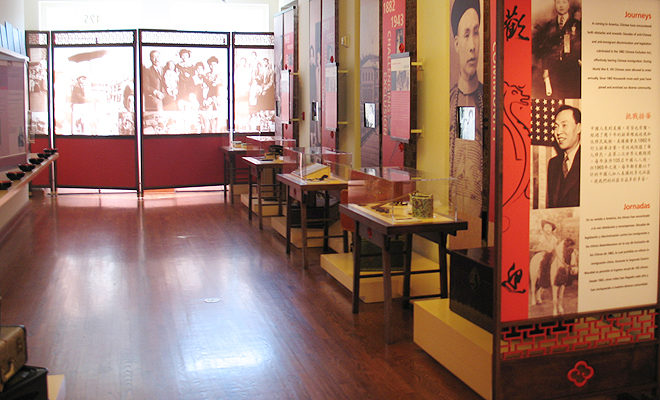
    The Museum will be located in the north bay of the Garnier Building, at the corner of Los Angeles Street and Arcadia Avenue, in the El Pueblo de Los Angeles Historical Monument. The Garnier is the only remaining building of L.A.'s Old Chinatown as well as one of the oldest existing Chinese commercial structure in California. The Museum will occupy the basement, first floor, mezzanine, and second floor of the 6,045 square feet site. MCAH will have exhibit galleries, offices, research centers, lecture halls, and a library.

    Museum architect Barton Choy and partner, E.J. Parish, are the principals of Choy Associates. Mr. Choy's father, Eugene Kin Choy, established the firm in 1947. He was one of the first Chinese Americans to obtain an architectural license in Los Angeles. (The other was the late Gilbert Leong, who was an MCAH board member.) For over fifty years, the firm has provided service to both public and private clients. Their projects have included public and commercial buildings, museums, exhibit design, interior architecture, and many projects specifically for the Chinese American community.

    Recent projects have included two major museum exhibit installations at the Huntington Library, retail store designs for MGM and Universal Studios, and three Los Angeles Public Library buildings, one of which was the Chinatown Branch Library.

    By Gerald Jann
    Board Member


    MCAH's Financial Backbone:
    The Chinese American Community in Southern California

    During the past year alone, over two hundred local businesses and generous individuals have assisted MCAH through funding contributions, artifact donations, and voluntary service. Most of them are Chinese Americans from Southern California. The Friends set out to learn about these supporters and uncovered intriguing stories of success. The following are profiles of five recent major Chinese American contributors.


    Center for Chinese Medicine

    [Mr. & Mrs Chan]
    Dr. Pedro Chan (C), Mrs. Pak Chan (L), and
    MCAH's charter president, Dr. Dan Louie Jr.,
    at last fall's fundraiser gala.

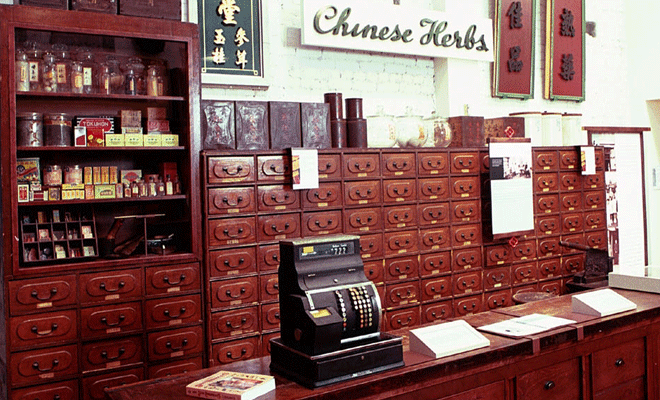
    On behalf of the Center for Chinese Medicine, founder and executive director Dr. Pedro Chan, contributed $50,000 in stocks to the museum project last fall. While browsing through MCAH brochures, he had read the plans for a Chinese herbal store exhibit. Inspired, he designated his donation to this exhibit which would commemorate the Chinese Americans' contribution to medicine.

    We are happy to do our share, Mr. Chan stated during MCAH's press conference of September 1997, and hopefully this will be the beginning for other donors to come forward. This donation is the largest the Museum has received from a private group.

    Founded in 1974, the Center for Chinese Medicine is a non-profit organization dedicated to educating the public as well as professionals about Chinese medicine and acupuncture. For its first sixteen years, the Center sponsored seminars nation-wide. At its peak, Pedro, together with ten doctors, conducted between fifty and sixty seminars annually. Over the years, this Chinese American organization helped to train over 25,000 doctors and nurses in America. Currently, the Center offers two annual scholarships, each in the amount of $1,000, to students of Chinese medicine and acupuncture.

    The Center for Chinese Medicine and its accomplishments are due to the efforts of Dr. Pedro Chan who had immigrated to Southern California from Macau in 1967. Shortly after earning his doctorate degree in biomedical engineering, he founded the Center for Chinese Medicine. Dr. Chan lives in Pasadena with his wife, Pak, and two children, Abby and David.

    By Sherie Yang
    Co-Editor


    Robert and Edith Jung

    [Mr and Mrs Jung]
    Edith (L) and Robert (R) Jung recently
    donated $10,000 to MCAH.

    Bob and Edith Jung have together witnessed the growth of Chinese Los Angeles from its early days. Married in 1948, the Jung's have been heavily involved in the Chinese American community through numerous organizations and activities, such as the Chinese American Citizens Alliance and the Chinese Historical Society of Southern California, among many others.

    Mr. Jung's father immigrated to the United States in the 1880s as a young man and arrived in San Francisco with great anticipation and eagerness about his future in the new land. As his father settled down, the Jung's became one of the earliest families to permanently establish themselves in America. Relocating to Los Angeles during World War II, Bob and Edith met through mutual friends and decided to proclaim their love in a life long commitment.

    Fifty years later, the Jung's have persisted in their dedication and loyalty to one another, as well as to the Chinese American community. As an expression of their devotion, they have generously donated $10,000 as a show of their desire to pass on their culture and history to the younger generation. Their benevolence is also in honor of Mr. Jung's father whose memory continues to inspire the lives of those he touched.

    Mr. and Mrs. Jung, who have been active Board Members of the Museum of Chinese American History since its inception, believe that this museum will take time for it to attain what it is conceptualized to be, but is certain that it is headed in the right direction.

    By Michelle Chung
    Co-Editor/Board Member


    DCH Automotive Group

    On behalf of DCH Automotive Group, Ms. Yim Hom presented $10,000 to the Museum last autumn. As business manager for the West Coast, Ms. Hom oversees all California dealerships. Mr. Shau-Wai Lam is the president of DCH, or Dah Chong Hong which means great, prosperous company in Chinese.

    This Chinese American firm was founded in the U.S. fifty years ago as a purchasing agent and importer/exporter of food products. In 1977, DCH established Paramus Honda, its first automotive retail business, in Paramus, New Jersey. Over the past two decades, DCH has expanded its automotive dealership holdings by acquiring top industry franchises including Toyota, Nissan, Saturn, Lexus, Volvo, Acura, Lincoln-Mercury, Jaguar, and additional Honda dealerships. Today, this company runs twenty- two franchises in twenty-one locations in New Jersey and California and has become what is known in the automotive industry as a "megadealer." Supported by a dedicated national team of 1,400 employees, DCH Automotive Group retails over 30,000 new and used vehicles annually and is approaching the $100 million mark in annual parts and service sales alone.

    Besides the automotive industry, DCH is very active in the ownership of commercial and residental real estate in New York, New Jersey, and California. Furthermore, the company's subsidiary, Dah Chong Corporation, is a leading importer/exporter of Asian food products.

    By Sherie Yang
    Co-Editor


    Southern California Chinese Produce Merchants Association

    [Southern California Chinese Produce Merchants Association]
    The officers at a recent meeting (from left to right):
    Mike Soo Hoo. Vice President
    Albert Quon, Director
    Lester Chew, Secretary-Treasurer
    Jose Wong, President

    On behalf of the Southern California Chinese Produce Merchants Association, Lester Chew, the organization's secretary-treasurer, contributed $10,000 to the museum at its fundraiser gala of October 1997. MCAH's charter president, Dr. Dan Louie Jr., is a long-time member and former president of the association.

    Founded in the 1930s, the association set out to assist and promote Chinese American produce merchants of the Los Angeles area. Through this organization, they networked at weekly meetings and entertained customers and friends at the association's annual New Year's luncheon. Most active in the 1950s through 1960s, more than fifty businessmen had participated in the organization at its peak. Members have included a diverse group of merchants representing every aspect of the produce industry; they have been vegetable and fruit growers, wholesalers and distributors for the domestic and international market.

    The founders of this early organization had played an important role in building the first wholesale produce market in Los Angeles. Known as the City Market, it occupied forty-five acres in the 900 block of San Pedro Street. Before 1890, Chinese American growers, wholesalers, and delivery workers provided ninety percent of all fruits and vegetables consumed by Angelenos.

    Over the years, many farmers and sellers of this historic organization have retired, while others have moved out of California. Today, its eight active members meet biennually and still organize their annual New Year's celebration. The association has also evolved into a charitable group focused on giving to the youth of the Chinese community. Recently, the Southern California Produce Merchants Association has donated thousands of dollars to the Chinatown Branch Library, Teen Post, and Castelar School.

    By Gerald Jann
    Board Member

    The Winter 1998 F-MCAH newsletter incorrectly associated the Southern California Chinese Produce Merchants Assocation with Joseph, Betty, and Gregory Wong. While they have no connection to each other, the Wongs and the Association both contributed $10,000 to the Museum.


    Mei Wah Club

    [Mei Wah Ladies]
    The Mei Wah ladies and friends at a recent luncheon.
    The officers are :
    Florence Francis, President (Out-going),
    Hazel Wong, President (In-coming),
    Ada Lee, Vice President,
    Sylvia Wong, Treasurer,
    Jane Tom, Secretary/Historian,
    Barbara Jean Lee, Parliamentarian

    On behalf of the Mei Wah Club, Barbara Jean Lee , a Friends board member, presented a $2,000 donation at the F- MCAH board meeting of May 1998.

    The Mei Wah (Chinese in America) Club, the oldest L.A. Chinese women's club which is still active, was formed in 1931 by ten Chinese American teenage girls as a basketball team. In subsequent years, Mei Wah expanded to become a charitable organization, providing financial assistance to the refugees of war-torn China in the 1930s. Under the guidance of club advisor Maye Wong, Barbara Jean Lee's mother, the enterprising young ladies organized Chinese relief benefits in the form of Christmas parties, Thanksgiving dances, and skating parties.

    [Mei Wah Lantern Girls]
    The Mei Wah Lantern Girls
    See bigger picture (88K JPEG)

    In 1938, the Mei Wah girls choreographed and rehearsed their routines and even sewed their own costumes in time to parade in the Moon Festival, the first large public assembly and fundraiser of United Chinese Relief. Thus, the first all-Chinese girl drum corps was born. Its director was David Soo Hoo, who was the brother of Peter Soo Hoo, the founder of L.A.'s New Chinatown. The corps had attracted many new drummers within a year. The drum corps traveled all over Southern California to perform in band contests and ultimately won numerous trophies during the 1940s.

    [Mei Wah Drum Corps]
    The Mei Wah Drum Corps

    In the decades after World War II, the Mei Wah girls directed their philanthropic efforts to the needs of the Los Angeles community. Always innovative, the ladies organized benefit carnivals, bazaars, and dances, often in their own backyards, and with the help of their husbands and children.

    Today, the fourteen active members continue their charitable activities. They meet once every two months and recently held their fifteenth annual fashion show fundraiser. The proceeds were donated to Belmont, Lincoln, and Marshall high schools as scholarships. Furthermore, the Mei Wah girls have contributed time and funds to support a diverse group of organizations such as the American Indian Group, the Chinatown Library, and the True Light Presbyterian Church.

    By Sherie Yang
    Co-Editor


    Taipei Economic and Cultural Office Donates $3,000

    [TECO Presentation]
    TECO presented a $3,000 donation to F-MCAH officers at a luncheon in March. Front row (L to R): Larry Wong, FCCBAA Executive Secretary, Judge Ronald Lew, F-MCAH President, Francias Lee, TECO Director-General, Edith Jung, F-MCAH 1st Vice President. Back row (L to R): Robert Jung, F-MCAH Board Member, Suellen Cheng, El Pueblo Curator, Jeffrey Tung, F-MCAH 2nd Vice President, Robert Kwan, F-MCAH President-Elect

    Director-General Francias Lee of the Taipei Economic and Cultural Office (TECO) in Los Angeles presented a $3,000 check from the government of the Republic of China to F-MCAH's President, Ronald Lew. At the March 23rd luncheon hosted by TECO, Lee stated, We make a modest donation to this worthy cause in the hopes that others may follow suit as in the old Chinese saying, "to throw a brick and get a jade in return."

    The Friends board of directors attended the luncheon along with Abraham Li (Director of the Chinese Culture Center), Jessica Lee (Secretary of TECO), and Larry Wong (Executive Secretary of the Federation of the Chinese Consolidated Benevolent Associations of America).

    Historically, Chinese Americans have not only contributed to the development of the American society, Director-General Lee explained, but also helped Dr. Sun Yat Sen in his efforts to establish the Republic of China. Today, Chinese Americans continue to play an important role in Sino-American relations. Francias Lee pledged to encourage community organizations and individuals to lend their support in building this important museum. He concluded, We must preserve our cultural heritage for our young people, so that they can know their roots.

    The Friends thanked Director Lee for his supportive words and donation. Judge Lew emphasized, Building this museum is a great challenge. If all different groups of our diverse Chinese community step forward and collaborate, together we can build the Museum of Chinese American History.

    By Suellen Cheng
    Curator


    Pieces of the Puzzle

    [Antique Cabinet] Antique cabinet from Dragon's Den, a trendy Chinatown restaurant in the 1930's. [Restaurant Chair] Chair used in the Dragon's Den Restaurant

    When my grandmother died, my family spent several months going through her things. She was Caucasian but had married into a Los Angeles pioneer Chinese family. Her father-in-law was Fong See; her husband, Eddy, had run Dragon's Den Restaurant; and she had worked for much of her adult life in the F. Suie One Company. Going through her rooms, closets, and sheds was like unearthing the history of our Chinese community. My grandparents had kept everything: programs from old Moon Festivals, menus, calligraphy practice books, laquerware, bambooware, pig skin chests, newspaper articles about Chinatown, and clothes worn by workmen.

    [Tiny Chair] Miniature chair, which fits on the palm of your hand, from the F. Suie One curio shop [Antique Trunk] Antique trunk from the See family home

    As with any family in the same circumstances, we struggled with what to do with all of these things. Some stuff obviously had sentimental or historical value, while a lot of it was plain old junk. Still, all of it had the potential to add to the pieces of the puzzle that make up our history, which is important because for so many years, Chinese American history has been buried, forgotten, or "lost." I could have repacked up this stuff and buried it again in my own garage. Or I could have tossed it all in the trash as so many people do. But I didn't want this history to be lost again.

    Suellen and Jean came out, got dusty with me, and took away a truckload of old chairs, some shipping crates, an old scale, baskets, an iron like the laundrymen used, a lottery- card making set, a lantern, a trunk, a cabinet from Dragon's Den, ginger jars, medicine bottles, interesting (and empty!) packaging, and some very old pots, pans, woks, and other cooking utensils. These objects were not what anyone would call "high art." They were the simple objects that showed how people actually lived, and nothing was too small or too insignificant. Remember, Suellen said, each piece is a part of the puzzle. It gives me great pleasure, and I know my grandparents would have been very happy as well, to know that these things have found a new home where people, especially the young, will be given the chance to experience Old Chinatown as it once was.

    Lisa See
    Writer

    Lisa See's first book was On Gold Mountain, a history/memoir of her Chinese American family. Her latest novel, Flower Net, is a suspenseful and beautifully written thriller. A former West Coast correspondent for Publishers Weekly, she lives in Los Angeles with her husband and two sons.


    Introducing the MCAH Website!

    With a few keystrokes, you may visit the Museum of Chinese American History (MCAH) on the World Wide Web. The MCAH website will feature exhibits, news, Chinese American history in Los Angeles, museum background information, past and recent newsletters, and volunteer information. Soon the traveling exhibits from the MCAH series will be on permanent display on the website.

    [Al's Picture in Guilin] My name is Al Wong and I have been building the MCAH's website for the last several months. I am the principal and senior computer consultant at Hummingbird Software, a Pasadena company which specializes in website creation, custom software development, and automated legal bill review.

    I stumbled upon the original MCAH website while surfing the Internet last summer. Through it, I learned about the Museum of Chinese American History and its need for volunteers. I immediately contacted curator Suellen Cheng about getting involved.

    There were three basic reasons I decided to get involved. First, the original website was outdated in various aspects and did not appear to be maintained. Second, it was a way for me to learn more about the history of L.A.'s Chinese Americans. Outside of my own family's history, I have little knowledge about the experiences of other Chinese in Los Angeles. Lastly, I feel there is an urgent need for a museum to describe/define our heritage in this city and I believe it is a worthwhile cause.

    The ways a website can promote the MCAH are tremendous. When compared to other media like print, television, and radio, it is most cost effective for world-wide information distribution. Furthermore, websites provide access 24 hours a day, 7 days a week. As information can be updated in a matter of minutes, current happening can be published on-line as they occur. It is an excellent way to attract supporters and keep everyone well-informed. Another important aspect, the website can be used as a beginning research tool on L.A.'s Chinese American history for students and scholars.

    Come visit the MCAH website at:

    http://www.mcah.org/
    If you would like your organization's website to be linked to the MCAH website, please use the HTML form at:

    http://www.primenet.com/~awong/hummingbird/contact.html

    You may also contact me at:

    Email: awong@primenet.com
    Voice: (626) 356-3300.


    Al Wong
    Hummingbird Software


    Why Build the Museum of Chinese American History?

    [Garnier Building]
    MCAH will be located in the historic
    Garnier Building in downtown Los Angeles

    Chinese Americans have played an integral role in the building of American society, but their efforts have been scarcely recognized by those who contend that the American Dream is not attainable by the very people that helped lay the foundations of this nation. This contention can be supported by a cursory look through any American history textbook. Authors generally boast the ingenuity and courageousness of the immigrants from the West, but very seldom regard the contributions of those from the East. Take, for instance, the construction of the transcontinental railroad in the 1860s that now stretches across the United States. At the completion of the massive undertaking, a historic photograph displays the Central Pacific and Pacific Union Lines joined at Promontory Point, Utah with Irish laborers perched atop the engines of the trains alongside the businessmen who funded the project. But where, we must ask, were the Chinese laborers who risked life and limb to be found? Hundreds upon thousands of lives were lost in the blasting through the Sierra Nevadas, yet the Chinese were rarely acknowledged for their contributions. This image in print affirms the lack of presence of Chinese Americans in the annals of United States History, thereby rendering us invisible and silencing our voices.

    [Calle de Los Negros]
    As early as 1850, Chinese sojourners traveled to Los Angeles,
    settling along the Calle de Los Negros
    which became Chinatown.

    Museums, then, play a crucial role in facilitating the linkages between what little has been said of Chinese Americans and the American Dream. Ethnic-themed museums have been only a recent phenomenon in the movement toward diversifying the museum scene. The desire and curiosity of mainstream America in understanding other cultures coincided with Third World and Civil Rights movements of the Sixties. It was at this time that Ethnic Studies began to capture the attention of academics across disciplines and was gaining momentum in the mainstream as well. Both of these elements combined caused an unprecedented burst of enthusiasm that catapulted interest in Asian American history and culture. At the forefront of this movement was the push toward education. Ethnic Studies began primarily as an intellectual movement focusing on the minority group experience by means of generating awareness and promoting greater understanding. This process of empowerment encouraged individuals to forge their identities as people shaped by intersecting cultural and social influences.

    What has been overlooked, however, are the roles of historical museums within the context of Asian American History. As with any experience, what is read in a textbook cannot be and is not conducive to real life experiences and interactions with those who have first-hand knowledge of a particular time and place. The interactive nature of the Museum of Chinese American History will offer a showcase of traveling and permanent exhibits allowing for its guests to become active participants during their visit. Not only will visitors be able to view the grand collection of historical artifacts, they will also have the opportunity to observe at close range the impressive displays of antiquities as well as contemporary objects.

    Founded on community interest, museums are perhaps one of the most accessible arenas for people desiring to expand their understanding of a specific area, namely the Chinese American experience. To meet the interests of the general public, academics, and scholars, the primary intent of the Museum of Chinese American History is to educate by collecting and disseminating information to supplement the little that has been written. Museums are especially authoritative in their body of knowledge because they carry with them an unquestionable degree of credibility and accuracy, with vast collections that directly relate to its themes and objectives.

    The great majority of museums that exist today primarily attract an adult audience. Only a limited number attempt to include younger audiences within its agenda. The basis for this type of programming is rooted in the belief that most museum attendees are adults with a specific interest. Younger audiences, however, should not be overlooked as they potentially have the most to gain, because their learning experience in the museum complements what they learn in the schools and can be useful in a variety of encounters.

    Given all such factors, the ultimate question stands: How can a museum facilitate the learning process of Chinese American history, and how can it affect the future of the Chinese in America? The answer lies in what people are able to take away with their impressions and understanding of what has been presented to them. Regardless of their gain, large or small, if the experience is an enduring one, then the museum's purpose has been served.

    By Michelle Chung
    Co-Editor/Board Member


    Asian Pacific Heritage Month

    [Chinese American Family Portrait] Chinese American families have been making Los Angeles their home since the 1870s.
    See bigger picture (59K JPEG)
    [WWI Asian Americans] Asian Americans have served in the U.S. military since World War 1.
    See bigger picture (77K JPEG)

    Asian Pacific Heritage Month represents a time to reflect on the experiences of our predecessors in their struggles and accomplishments. Nationally recognized during the month of May, Asian Americans come together in celebration of the similarities among Asian Americans as a panethnic collective as well as commemorating the contributions of individual ethnic groups through the sharing of culture. Asian America has come to represent a rich and diverse collection of experiences, evolving immensely from its early beginnings to its contemporary state.

    In the nearly two hundred years of Asian American presence in the United States, enormous contributions have been attributed to the labors of groups and individuals of Asian-descent. The initial catalyst for Asian immigration began with the need for cheap labor in the industrialization of the American West and Hawaii. Among the earliest groups to emigrate were the Chinese who experienced high levels of interaction with foreigners as a consequence of their coastal geographical location in China. Recruited en masse to construct the transcontinental railroad and to provide farm labor, the Chinese were recognized for their diligence and enterprise. Businessmen and profiteers acknowledged the possibilities resulting from the exploitation of Chinese labor and began enlisting the labor of other groups as well. Shortages in cheap labor were soon supplemented by the Japanese and the Filipinos, and in smaller numbers by Koreans and Asian Indians, who were instrumental in the growth of the agricultural industry in the West Coast as well as in Hawaii.

    Racial animosities towards Asians in the United States intensified due to their increased presence. Chinese became known as the yellow peril and Asians were designated as foreigners and aliens. To justify the hostilities pitted toward them, politicians and lawmakers enacted legislation to substantiate their desire to confine the rights and movements of those whom they perceived as threatening to society. Included in these legal constraints were restrictions on immigration, prohibitions on property ownership, limitations to occupational participation in mainstream sectors and denials of citizenship. Among the most ominous of these was the 1882 Chinese Exclusion Act that barred individuals of Chinese ancestry the right to enter the United States, setting precedence for later measures restricting the movements and drastically limiting the freedoms of other Asian groups.

    World War II marked another bleak chapter in the history of Asians in America with the enactment of Executive Order 9066 by President Franklin Roosevelt. Without consideration to the nationalist loyalties of Asian Americans, the administration granted the president the authority to incarcerate all Japanese, regardless of citizenship status, prompting a horrendous relocation of a single group on the sole basis of ethnicity on the premise that they were potential threats to American society. Minimal regard was given to the participation of Asian Americans in the war and the human casualties suffered as a result of their courageous efforts.

    The passage of the Immigration and Naturalization Act of 1965 is considered symbolic of the changing tide of global migration. This legislative measure has served as a conduit for a new amalgamation of peoples desiring to move to the United States. As a consequence, there has been a tremendous growth in the Asian Pacific American population in the United States resulting primarily from the rewriting of immigration laws that were previously detrimental to groups of Asian origin intending to settle permanently. Of the various categories under which individuals petition for immigration, the most prevalent is that of family reunification. Prior to 1965, Asians in America were primarily young men from economically depressed areas recruited for their labor in the United States, leaving their families at home due to the harsh conditions abroad. The post-1965 era is significantly different in its composition of immigrants with the movement of groups with higher education, greater capital, and a richer ethnic diversity, i.e. immigration of Southeast Asians, especially visible in the post-Vietnam War era. Furthermore, the formation of families is much more striking as the transplantation of intact family units and the growth of American-born generations take greater precedence.

    Locating Asian America within mainstream America requires an understanding of the historical events that have shaped the past and a recognition of the implications it has for the future. Reflecting upon the complexities of Asian America, it becomes apparent that ethnic history is intertwined intricately with the affairs of the United States and the world. Asian Pacific Heritage Month is a time to collectively reconsider what it means to be Asian Pacific American within the context of past and present social, political, economic, and racial climate. Today's Asian America must be genuinely inclusive of all individuals of Asian descent and not only the previously dominant Chinese, Japanese, and Korean. This rethinking in the academy and the community will generate a greater awareness and appreciation of the diverse history and experience of all Asian Americans.

    By Michelle Chung
    Co-Editor/Board Member

    Michelle Chung was recently awarded the Regent's Fellowship to U.C. San Diego as a Ph.D. student in the department of Ethnic Studies. She earned her B.A. in Sociology from U.C. Irvine and was a Getty intern at MCAH in 1996.


    What's New?

    Second Annual Fundraiser Gala

    The Friends is currently planning MCAH's second annual fundraiser gala. The dinner event will take place on October 6, 1998, at the Regal Biltmore Hotel in downtown L.A.

    Donors' Reception

    MCAH held a special reception on July 1, 1998 to honor the individuals and organizations who have generously contributed to the Museum.

    Getty Multicultural Summer Internship Program

    F-MCAH and El Pueblo received a grant from the Getty Multicultural Summer Internship Program (for the sixth consecutive year!) to hire two outstanding students. Roseline Lum (from California State, Fullerton) and Amy Tien (from California State, Northridge) joined MCAH in mid-June and will assist El Pueblo staff in creating a new interpretive exhibit showcasing the Museum's artifact collection.

    Trip to the Getty

    During February, F-MCAH board members traveled to the Getty Center for a reception which was held especially for organizations who have won grants from the J. Paul Getty Trust.


    If your name or company is mentioned in this newsletter and you wish us to link to your home page or email address from this newsletter, please tell the webmaster through this contact form.

  • [Home]
    Home


    [Hummingbird Software Logo]
    Web Page by Hummingbird Software

    Content is Copyright 1998 Museum of Chinese American History in Los Angeles
    Los Angeles, California, USA
    All rights reserved.